



Living Sky
Space is your instrument.
Living Sky is a spatial mixing engine and reverb that recreates the resonance of real spaces as ultra-high-resolution 3D sound fields.
Living Sky plug-in
Inside your DAW
3D Control App
Linked to the plug-in
Position your tracks, shape and move the acoustics around them, and let the space respond to the sound itself, all within one seamless spatial mixing workflow.
- 64
- Source inputs
- 5
- Reverb buses
- 3
- Spaces per bus
- 32
- Modulation slots
- 5th
- Order Ambisonics
Under the hood, Living Sky runs hundreds of convolutions on the GPU in real time, blending and transforming recorded responses. That gives you the realism and directional detail of captured spaces, with the movement and modulation of an algorithmic reverb.
Watch Living Sky
Demos, walkthroughs and conversations on the making of Living Sky.
Living Sky Explained: Spatial Engine for Immersive Audio
Listen
Hear Living Sky in action.
Switch between the dry audio and the Living Sky mix to hear the changes in depth, reflections and movement.
01 / 09
Machaut's Kyrie
Credits
Kyrie from “Missa de Notre Dame” of Guillaume de Machaut (1300-1377).
Spatial mix made with Living Sky.
INSIDE LIVING SKY
Control the entire spatial scene.
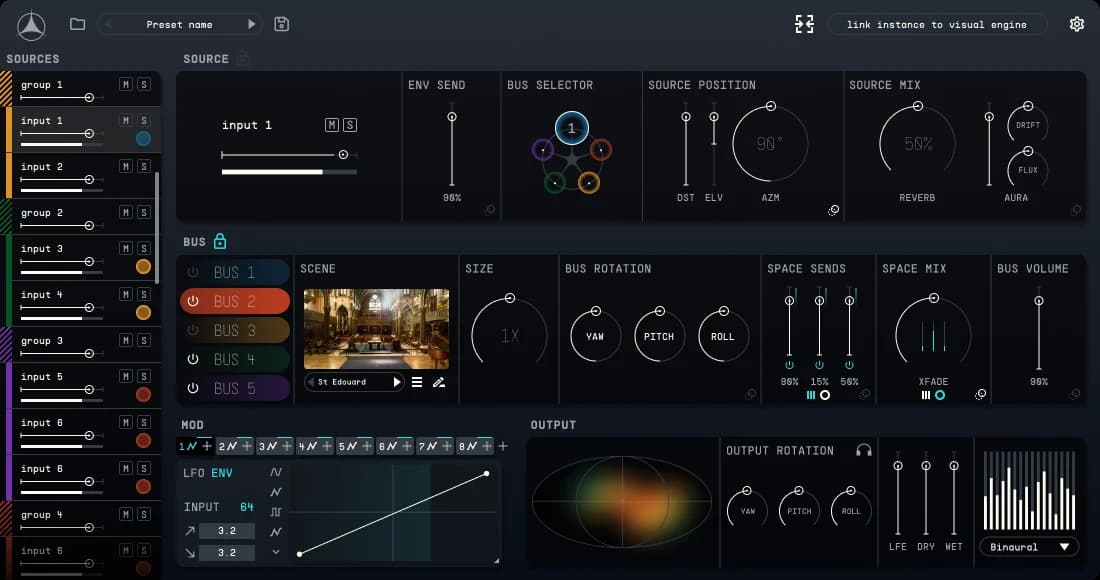
Position your sources, build the acoustics around them, put the field in motion and shape how it responds. Everything stays connected in one seamless spatial mixing workflow.
Place sound in 3D.
Position up to 64 sources around the listener and adjust their distance, height and direction.
- Position
- Set each source's distance, elevation and azimuth.
- Sharpness
- Keep a source tightly defined or spread its presence across the sound field.
- Groups
- Move several sources together while preserving their relative positions.
The Space Library
Real spaces, captured in 3D.
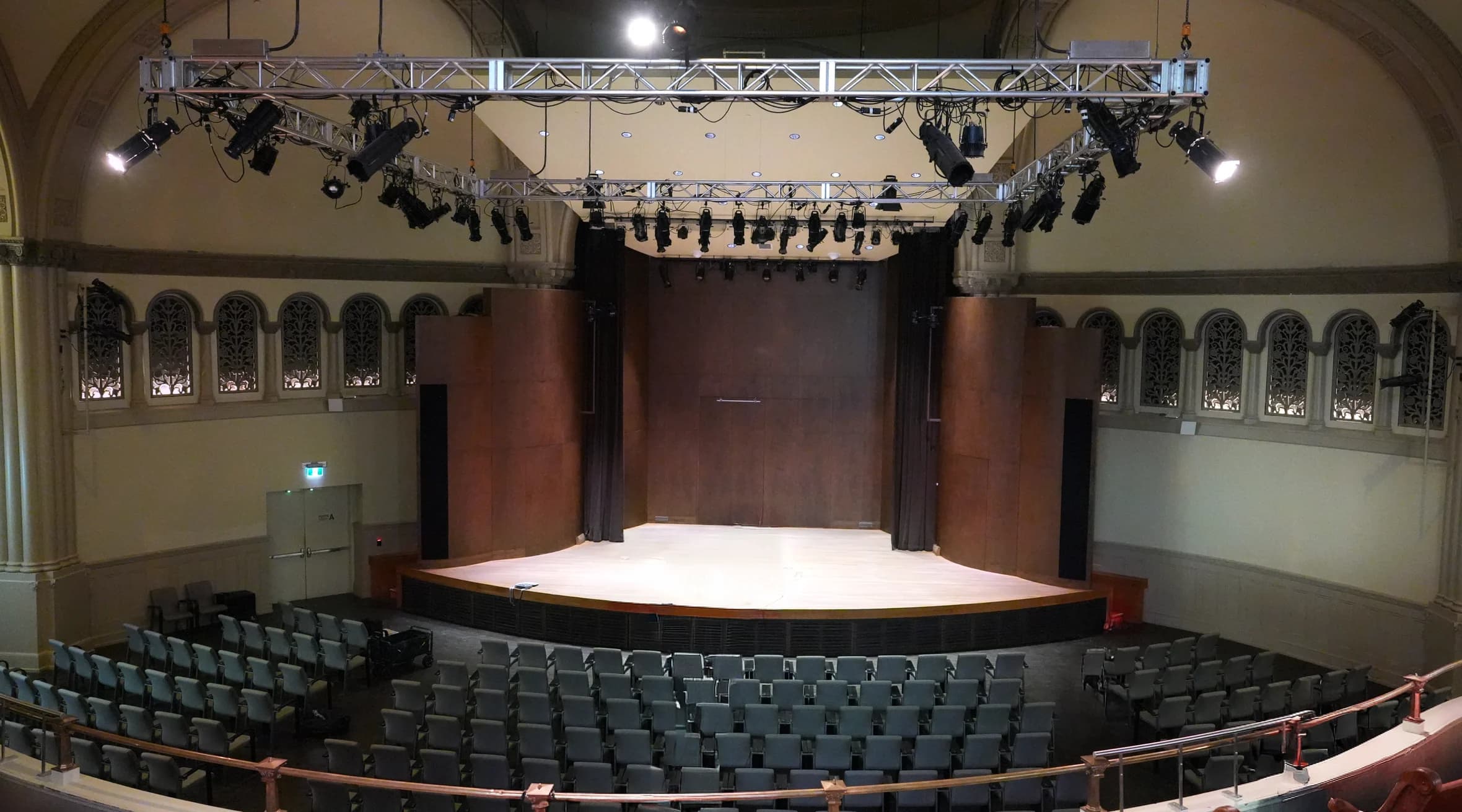
Our growing library brings together over 120 high-resolution spatial responses captured from real locations, using higher-order Ambisonics (HOA) and our proprietary microphone arrays. We captured many rooms from several positions, giving you different perspectives on their reflections and resonance.
Living Sky also includes virtually modelled Spaces created by Lese Audio.
01 / 47
Salle Bourgie
Mix, design and perform with space.
Build a spatial mix, transform a sound through its reverberation, or make the acoustics respond to a performance. Living Sky brings source positioning, high-resolution reverb and modulation together, giving you control over both the sound and its surroundings.
Spatial mixing
Place voices, instruments and effects in real captured spaces, or give each its own surroundings. Control the position of your sounds and the movement of their reflections independently.
Sound design
Turn an impact into a changing resonance or surround a sustained tone with moving reflections. Combine and reshape Spaces to make the reverberation part of the sound you are creating.
Reactive performance
Let the incoming sound drive changes in the acoustics. Combine audio-responsive processing with modulation and automation so the space changes with the performance.
Your mix, in any format in seconds.
Living Sky was built to be format agnostic. Because the mix stays Ambisonic until decoding, you can move up or down between stereo, binaural, surround and immersive formats without mixing again or changing how your selected Spaces resonate. Mix once, deliver any supported format, or export the Ambisonic field directly.
ONE SPATIAL MIX
Sources · Selected Spaces · Movement · Modulation
CHOOSE THE OUTPUT
Headphones & stereo
Mix and deliver in stereo, or listen binaurally on headphones, from the same spatial scene. Living Sky also supports OSC head tracking for compatible devices, allowing the binaural perspective to follow the listener's movement.
- Stereo
- Binaural
- OSC head tracking
Surround & immersive
Decode for multichannel and height-speaker playback without rebuilding your source positions, selected Spaces or modulation settings.
- Quad
- Cube
- 5.1
- 7.1
- 7.1.2
- 7.1.4
- 7.1.6
- 9.1.6
- 22.2

Ambisonics
Export the field as AmbiX for ambisonic workflows. The output order follows the internal processing setting.
- AmbiX 3rd order
- AmbiX 4th order
- AmbiX 5th order
Decoder variants
Film and SMPTE decoder variants are available for supported surround and immersive layouts.
SMPTE
5.1 · 7.1 · 7.1.2 · 7.1.4 · 7.1.6 · 9.1.6 · 22.2
Film
5.1 · 7.1 · 7.1.2 · 7.1.4 · 7.1.6 · 9.1.6
Available layouts depend on your DAW's channel routing. Mastering Dolby Atmos ADM files requires a Dolby Atmos renderer.
Testimonials
“I've mixed over 3,000 songs in Atmos, and I've never heard anything like it in my life.”
Justin Gray
GRAMMY® Award winner for Best Immersive Audio Album, Immersed
justingraysound.com
“I'm hesitant to even start out calling this a "reverb" as it's almost a whole system in and of itself.”
Matt Anderson
Tape Op
Tape Op
“Living Sky has become my primary spatial reverb. The tech is crazy and it sounds very good.”
Philippe Rochefort
Sound Supervisor, PHI Montreal
PHI Montreal
The making of Living Sky
Three teams, three years, and decades of combined research and development.
Developed in partnership with Outer Echo and Soundcore.



Get Living Sky.
Buy the full version or start with the 30-day trial.
Refund policy
Please use the 30-day Living Sky trial to confirm compatibility and fit before purchasing. Because Living Sky is delivered as a digital license, direct purchases are final once the paid license is downloaded or redeemed. We will refund duplicate charges, accidental purchases requested within 14 days before download or redemption, and purchases where Living Sky cannot be made to function on a published supported configuration after a reasonable support attempt. Any refunded license and its activations will be revoked.
Full version
$799
Up to three of your own computers, for one person. Your license can't be shared. Never discounted.
30-day trial
FREE
30 days · 4 sources · Stereo and Binaural · a selection of Spaces.
One of your own computers, for one person. Can't be shared. Your trial starts when you redeem. Trial output is for your own non-commercial internal evaluation unless you hold a paid, unrefunded Living Sky license.
Included with Living Sky
Plug-in, app and processing engines
Available as VST3, AU and AAX, with the 3D Control App, Audio Processing Engine and GPU-Audio Engine.
Main Space Collection
120+ spatial responses from real locations.

Lese Audio Space Collection
Imagined, virtually modelled acoustic responses created by Lese Audio.
Download + Activations
Download through your MNTRA account and activate on up to three of your own computers, for one person. Your license can't be shared.
Before you install
System requirements.
The Living Sky plug-in and linked 3D Control App run on both Mac and Windows. A supported GPU is required for processing the acoustic responses.
SPATIAL SUPPORT
Tested DAWs
Pro Tools Studio and Ultimate · Nuendo · Cubase Pro · Reaper · Logic Pro
SPATIAL SUPPORT
Tested DAWs
Pro Tools Studio and Ultimate · Nuendo · Cubase Pro · Reaper · Logic Pro
The DAWs below have been tested with Living Sky for multichannel spatial routing. Available channel width is determined by the host.
Multichannel spatial

Pro Tools Studio and Ultimate
Up to 64 Living Sky source inputs in Ultimate. Studio works within its smaller channel widths.

Nuendo
Up to 25 channels / 4th-order Ambisonics

Cubase Pro
Up to 25 channels / 4th-order Ambisonics

Reaper
Up to 64 Living Sky source inputs
Logic Pro
Up to 7.1.4 (12 channels)
VST3, AU and AAX formats open in almost every DAW. The limitation is the maximum channel size a DAW supports to work on spatial audio. Living Sky supports up to 64 source inputs per instance, and the number available to one instance depends on the channel routing supported by the DAW. You can run multiple instances, depending on your system.
Other DAWs · Stereo
Ableton Live
Stereo
Living Sky runs in stereo in every other VST3, AU and AAX host — multichannel spatial routing is not certified in them. That includes Ableton Live. We are continuing to certify multichannel spatial routing in additional DAWs.
Good to know
- Living Sky can't be guaranteed to work in more than 1 DAW simultaneously.
- Multiple instances won't be supported in the same DAW if sandboxing (multi-process) is enabled in the DAW.
Not sure about your setup? Contact MNTRA Support. We're happy to help.
Mac
 Mac
- Processor
- Apple silicon (M1-M5). Intel Macs are not supported.
- Operating system
- macOS 13 to 26.
- System memory (RAM)
- 16 GB or more. On Apple silicon this one pool of memory is shared with the GPU.
- Disk space
- 5 GB
Windows
 Windows
- Processor
- Supported Intel or AMD CPU
- NVIDIA GPU
- GeForce 10-series or newer.
- AMD GPU
- Radeon RX 6800 or a newer supported model.
- Operating system
- Windows 10 22H2 or Windows 11.
- System memory (RAM)
- 16 GB or more. This is your computer's RAM, separate from your graphics card's own memory.
- Disk space
- 5 GB
 NVIDIA GPU
 AMD GPU
Sample rateLiving Sky runs optimally at 48 kHz. Higher sample rates can work, but processing load compounds with sample rate, so what runs smoothly depends on your system.
More system info
Capacity per instance
5
Reverb buses
3
Spaces per bus
36
Channels per Space
64
Source inputs
The number of buses and channels are maximums supported, not guaranteed.
Typical sessions, 1 to 6 Spaces and 1 to 32 sources at moderate buffer sizes, run on modern computers. Fully loaded sessions need mid-to-high-tier production hardware.
Processing load depends on the loaded Scenes, internal Ambisonics order, sample rate, buffer size and hardware.
Note on Maximum Routing Performance
Our architecture supports up to 5 buses wherein each of the buses may comprise up to 3 spaces each comprising up to 36 channels of audio processing, plus 64 simultaneous input sources. Please note that maxing out these routing matrices exponentially increases real-time computational demands. While baseline modern computers handle standard configurations flawlessly (e.g., 1 through 6 simultaneous spaces and 1 through 32 input sources at moderate blocksize / latency configurations), running fully loaded sessions strictly requires mid-to-high-tier production hardware. Entry-level or baseline processors do not possess the physical hardware overhead required to run maximum configurations, regardless of your DAW's buffer block size.
Learn Living Sky.
Guided lessons, DAW workflows, and field notes. An ever-growing set of resources.
- Lessons
- 71
- Controls explained
- 58
FAQ
How is Living Sky different from a conventional reverb?
Living Sky treats spatial positioning and reverb as one cohesive system. Built around ultra-high-resolution spherical captures and multi-position acoustic recordings, it retains reflections from around, above, and below the listener, delivering a level of directional detail, density, and natural diffusion that conventional stereo and multichannel impulse responses cannot match. Beyond point-source panning on top of reverb, Living Sky allows bridging source placement and room response excitation. Across its rendering modes, source positioning and signal dynamics influence how sound energizes the captured acoustic field—allowing the space to respond with the depth and unpredictability of a real room. Blend up to three Spaces per bus and reshape their character to create entirely original acoustics that blend algorithmic flexibility with real-room authenticity, delivering a unified sound field that translates seamlessly from immersive setups to stereo.
Is Living Sky a reverb or a spatial mixer?
Both, in one plug-in. Position your sources in 3D and Living Sky reverberates them in the same 3D sound field, so it works as a spatial mixer, a reverb, or both at once. To use it purely as a spatial mixer, turn off the reverb buses, and the source positioning, source modulation and output decoding remain available. You can also bring the Wet fader down, to have only the direct path in the output. To use it purely as a reverb, bring the Dry fader down, and you will hear only the sound going through the Reverb Buses.
Can I use Living Sky as a stereo reverb?
Yes. Living Sky is an outstanding stereo reverb even in stereo-only DAWs. Use it as an insert on a stereo track or on an auxiliary bus fed by sends from your DAW. Space blending, EQ, Size, movement, modulation and Aura stay available.
What is Aura?
Aura is Living Sky's proprietary, source-responsive reverb send. It runs in parallel with the main Reverb send and responds to each source's position and energy distribution. Control its level independently, use it on its own or blend it with the main reverb. Drift controls the depth of Aura's modulation; Flux controls its rate.
How do HOA captures and MNTRA's custom arrays differ?
Higher-order Ambisonics (HOA) microphones have a distinct physical architecture, with microphones positioned in a specific configuration around a sphere. Our proprietary arrays were developed over four years of acoustic research. They use custom microphone configurations, including ultrasonic-capable microphones, to capture additional perspectives and extended frequency detail. The library includes Spaces from these complementary capture approaches, which can be used individually or blended within a Scene.
What are Spaces and Scenes?
A Space is an acoustic response from the library, captured from a real location or virtually modelled. A Scene combines up to three Spaces with independent EQ and Size settings. Each of Living Sky's five reverb buses holds one Scene, allowing up to 15 Spaces in a single instance.
Will there be more Spaces?
Yes. We are continuing our spatial capture work and will expand the library with new Spaces. The collection already includes captures from Montreal and Mexico City.
Which DAWs support Living Sky's spatial workflow?
We have tested Living Sky's multichannel spatial routing in Pro Tools (Studio and Ultimate), Nuendo, Cubase Pro, Reaper and Logic Pro (up to 7.1.4). Available input channels and output formats depend on the DAW limitations and session routing. Living Sky also runs in stereo in supported DAWs, including Ableton Live. We are testing additional DAWs for multichannel support. Living Sky comes in VST3, AAX and AU formats, so it can be loaded in DAWs that support them. DAW support and channel limits.